7 Canny Alternatives for Indie Hackers (2026)
Canny Pro starts at $79/mo, but 70% of indie SaaS earn under $1K MRR. Here are 7 cheaper alternatives — free tiers, self-hosted, and flat pricing included.

Founder of Peeqback
Canny charges $79/month minimum for its Pro plan. The median indie SaaS earns $500/month in MRR (RockingWeb, 2025). The math is broken before you even start.
If you're a solo founder or bootstrapped builder, you didn't spend six months writing code so you could hand 16% of your revenue to a feedback tool. You need something that fits an indie hacker budget — under $20/month, free if possible, and ideally with no tracked-user billing trap. So what actually fits?
This guide ranks 7 real alternatives, including self-hosted options, a genuinely free pick, and the case for using nothing at all. Fair disclosure upfront: I run Peeqback, which appears at #7. I've tried to rank honestly, and you'll see the tradeoffs for each option laid out the same way.
Key Takeaways
- 70% of independent SaaS products earn under $1,000 MRR — Canny's $79/mo Pro plan eats 8% of that revenue before any infrastructure cost (MicroConf, 2024)
- Fider is open-source and free forever if you self-host; managed hosting starts around $14/mo via third-party providers
- Featurebase and Sleekplan offer real free tiers that survive past Canny's 25-tracked-user cap; Peeqback offers a $19/mo flat plan or a $149 one-time lifetime plan with a 7-day money-back guarantee
- GitHub Discussions is $0 and works well if your users are developers who already have GitHub accounts
Why Is Canny Too Expensive for Most Indie Hackers?
Canny's Pro plan starts at $79/month and can climb to $1,349/month based on tracked users (Featurebase, 2026). For a solo founder with $500 in monthly recurring revenue — the median for micro-SaaS products — that's 16% of revenue spent on one tool (RockingWeb, 2025). No bootstrapped business survives that math for long.
The tracked-user billing model is the real issue. Every person who posts, votes, or comments counts as a tracked user, and your costs scale from there. A successful feature vote that pulls in 500 voters can push your bill past its cap in a weekend. You get charged overage fees for the exact behavior you were trying to encourage. Who's going to keep paying that — and more importantly, why should they have to?
Here's what the revenue distribution looks like across 1,000+ micro-SaaS products: 30% never reach $1,000 MRR, another 50% plateau between $1K and $10K, and only 5% exceed $100K (RockingWeb, 2025). If you're in that 80% band, Canny's pricing model is structurally misaligned with your business size.
Canny isn't a bad product. Notion, Loom, and ClickUp use it for good reasons. But those companies have budgets — you don't. The question isn't whether Canny is worth $79/mo; it's whether $79/mo is worth it to you when working alternatives exist at $0 to $29.
What Should an Indie Hacker Look for in a Feedback Tool?
Three things matter: a low-risk way to evaluate the tool — either a free tier that survives past week one or a money-back guarantee — flat pricing with no per-user billing, and setup time under 15 minutes. Everything else is a distraction when you're shipping solo. 72% of businesses now use feedback tools to improve customer engagement (Global Growth Insights, 2025), but enterprise checklists don't help a one-person team.
You need the core loop: collect feedback, prioritize by votes, close it publicly when you ship. That's it. Salesforce integrations and advanced segmentation are noise until you have a real sales team and a real support team — neither of which exists at $500 MRR.
Here's the honest filter I'd apply before picking any tool:
- Money-back guarantee or real free tier, not a 14-day trial that lapses into a charge. You need a way to prove the workflow works without lock-in.
- Flat or per-workspace pricing. Tracked-user billing punishes the engagement you want.
- Public roadmap and changelog built in. Users need to see their requests move.
- Embeddable widget, not just a hosted page. In-app context drives better feedback than email.
- Setup in 15 minutes. Your evenings are for shipping, not configuration marathons.
Here's the contrarian take most alternatives articles skip: if you have fewer than 10 paying users, you don't need a feedback tool at all. You need 30-minute calls with those 10 people. Tools replace 1-on-1 conversations once conversations stop scaling — not before. We'll come back to this at the end.
The 7 Canny Alternatives Worth Considering in 2026
These seven tools span the full range — from free open-source to $29/mo bootstrapped SaaS. I've ranked by indie hacker fit: free tier quality, pricing floor, and setup friction. If you need enterprise CRM integrations, most of these won't work (go back to Canny). For everyone else, one of these will fit.
1. Fider — The Open-Source, Self-Hosted Option
Fider is MIT-licensed and runs with one Docker command. Self-hosting costs nothing beyond your server — which for most indie hackers is a $5 DigitalOcean droplet or a free-tier container on Railway or Fly.io (Fider on GitHub). It's the only option on this list with a legitimate $0 total cost.
What you get: voting boards, threaded comments, tags, status updates, admin dashboard. What's missing: native Slack/Discord/Jira integrations, AI features, polished analytics. You can build integrations via webhooks, but you're the one building them.
If you self-host, budget roughly 1–2 hours/month for updates, backups, and SSL renewals. If your time is worth $50/hour, that's a hidden $50–$100/month — still cheaper than Canny Pro, but not free. Best fit: technical founders who already run infrastructure they trust.
Managed Fider hosting through Elest.io starts at $14/mo, which removes the ops burden while keeping the open-source benefits. The Stack Overflow 2025 Developer Survey found Docker usage jumped 17 percentage points year-over-year — the largest single-year gain across all surveyed technologies (Stack Overflow, 2025). Self-hosting has never been more accessible.
2. UserJot — The Bootstrapped Indie Darling
UserJot is built by a solo founder, for solo founders. Pricing is flat and per-workspace: $29/mo for Starter, $59/mo for Professional, with no tracked-user penalty (UserJot pricing). That flat model is the main draw for indie hackers who want predictable bills.
The free tier is generous: unlimited users, unlimited posts, and 2 boards on a userjot.com subdomain. That's enough to run a real feedback loop for a small SaaS without paying anything. Upgrading unlocks custom domain, integrations, and unlimited boards.
UserJot's weakness is maturity — fewer templates, fewer third-party integrations, and a smaller ecosystem than Canny or Featurebase. For an indie hacker, that trade is usually fine. You get flat pricing, a founder who responds to support requests personally, and a tool that won't surprise-bill you during a traffic spike.
3. Featurebase — The Generous Free Tier
Featurebase has the most generous free tier on this list. You get feedback boards, a public roadmap, surveys, and a help center with 50 articles — all on the free plan, all in one tool (Featurebase pricing). Paid plans start at $29/seat/month for Growth.
For teams under 2 years old with fewer than 6 employees, Featurebase offers an 86% startup discount on paid plans. That drops a $29/seat plan to roughly $4/seat, putting real feature parity within an indie hacker budget — assuming you qualify and remember to apply.
The catch: seat-based pricing adds up if you bring in collaborators. One solo founder at $29/mo is fine; three co-founders at $87/mo is not. Check the math before inviting your technical co-founder to the workspace. If you're truly solo, Featurebase's free tier alone handles everything a pre-$5K MRR product needs.
4. Sleekplan — The All-in-One With an Indie Free Tier
Sleekplan bundles feedback, changelog, roadmap, CSAT, NPS, surveys, and sentiment AI into one product (Sleekplan pricing). The "Indie" free plan includes unlimited feedback, 500K pageviews, and the feedback + changelog modules — with no time limit.
Paid plans start at $13/mo for Starter (3 seats, full feature set) and $38/mo for Business (10 seats). That $13 entry point is the lowest real paid tier on this list, which matters when you need a custom domain or the full roadmap module.
The downside is UX density. Sleekplan tries to do a lot, and the admin panel reflects that — more tabs, more settings, more things you'll probably never use. If you want a minimal tool that does one thing well, look at UserJot or Peeqback first. If you want maximum features per dollar, Sleekplan is tough to beat.
5. Frill — The No-Free-Tier Budget Pick
Frill is the odd one out here: no free tier, only a 14-day trial. But the Startup plan — $25/mo with 50 ideas and 1 survey — lands below Canny's practical starting point in feature value (Frill pricing). If you've already validated the feedback workflow on another tool and you're ready to upgrade, it's a reasonable pick.
Where Frill wins is design. It's the most polished of the budget-tier tools. Ideas board, roadmap, and changelog integrate cleanly, and the embedded widget looks premium without customization. For B2C products or design-adjacent SaaS, that visual quality matters.
I'd skip Frill if you haven't validated the workflow yet. Fourteen days isn't enough to know whether a feedback tool fits your workflow. Run Featurebase free or Sleekplan Indie for a month first, then move to Frill if design polish becomes the bottleneck.
6. GitHub Discussions — The Truly Free Option
This one isn't a traditional Canny alternative, but hear me out. If your users are developers and your product lives on GitHub, Discussions and Issues already give you threaded feedback, upvoting (via reactions), status tracking via labels, and a public roadmap via Projects. All free. All where your users already are.
For developer-tools SaaS under $10K MRR, GitHub Discussions can outperform dedicated feedback tools on engagement, because users don't have to create a new account just to vote. The trade-off is polish — you can't customize the board, you can't embed it on your site, and non-technical users find the interface intimidating. If your ICP is "people who already have a GitHub account," that's a non-issue.
Pair Discussions with a manual weekly triage (15 minutes) and a public roadmap repo, and you've replicated about 70% of Canny's value for $0. The remaining 30% — embedded widgets, auto-notifications, non-technical-friendly UX — is where you'll eventually outgrow this setup. That's the moment to move to one of the paid tools above.
7. Peeqback — The Flat-Rate Pick (Disclosure: This Is Our Tool)
Fair disclosure one more time: I run Peeqback. Read what follows with that in mind.
Peeqback is flat-rate: $19/mo recurring or $149 one-time for lifetime access — no tracked-user billing, no tiers, same features either way. Every paid plan includes unlimited boards, voters, team members, a public roadmap, and a changelog. We back it with a 7-day money-back guarantee so you can validate the workflow before settling in. We built it to fix the pricing model that makes Canny painful for indie hackers.
What we do well: one-click emails to everyone who asked when their request ships (not just a digest email), flat pricing that doesn't punish growth, and 5-minute setup with an embeddable widget. What we don't do yet: Jira, Linear, Salesforce, or HubSpot integrations. If those are on your must-have list, use Canny or Featurebase instead — we're upfront about the gap.
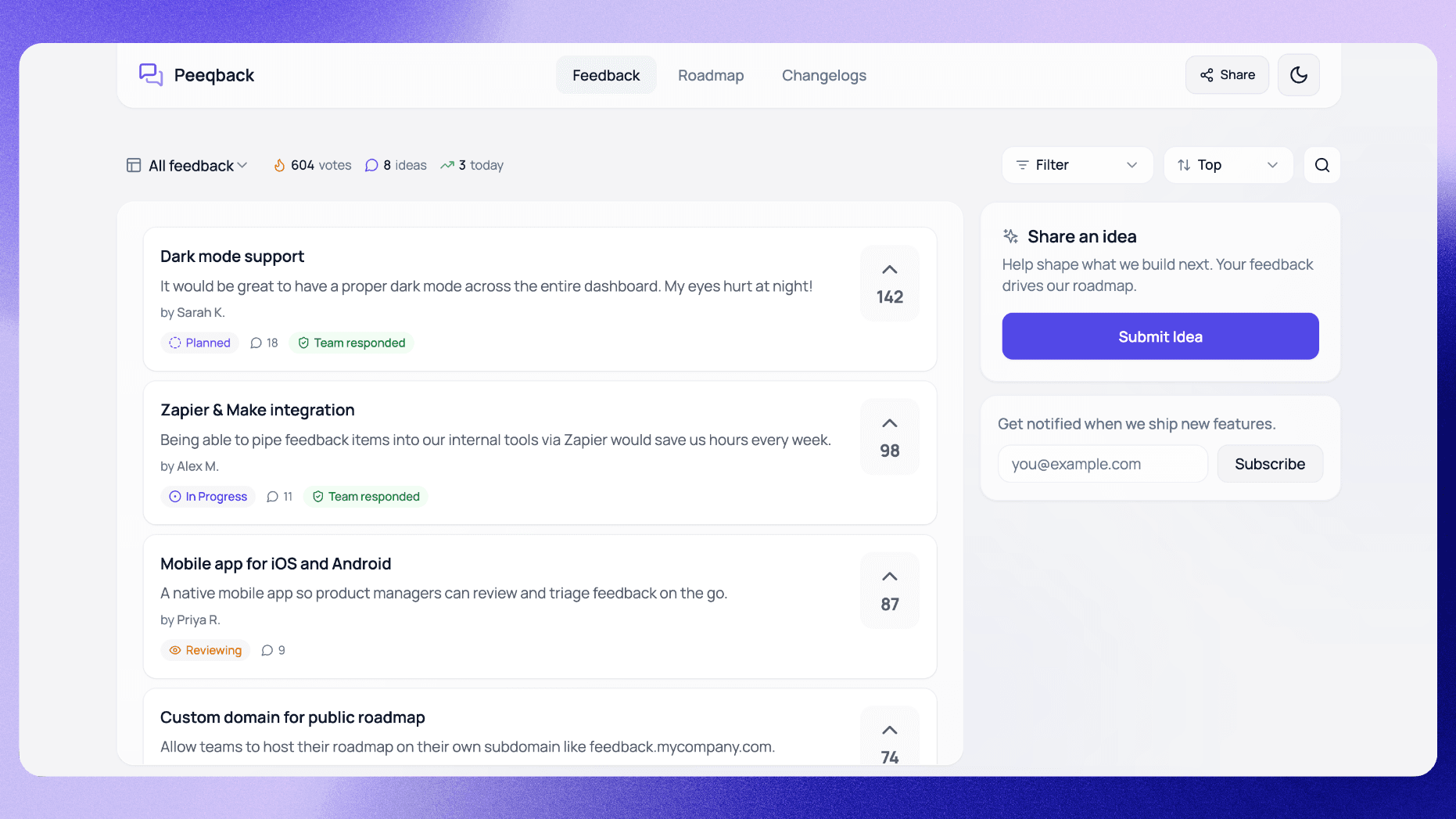
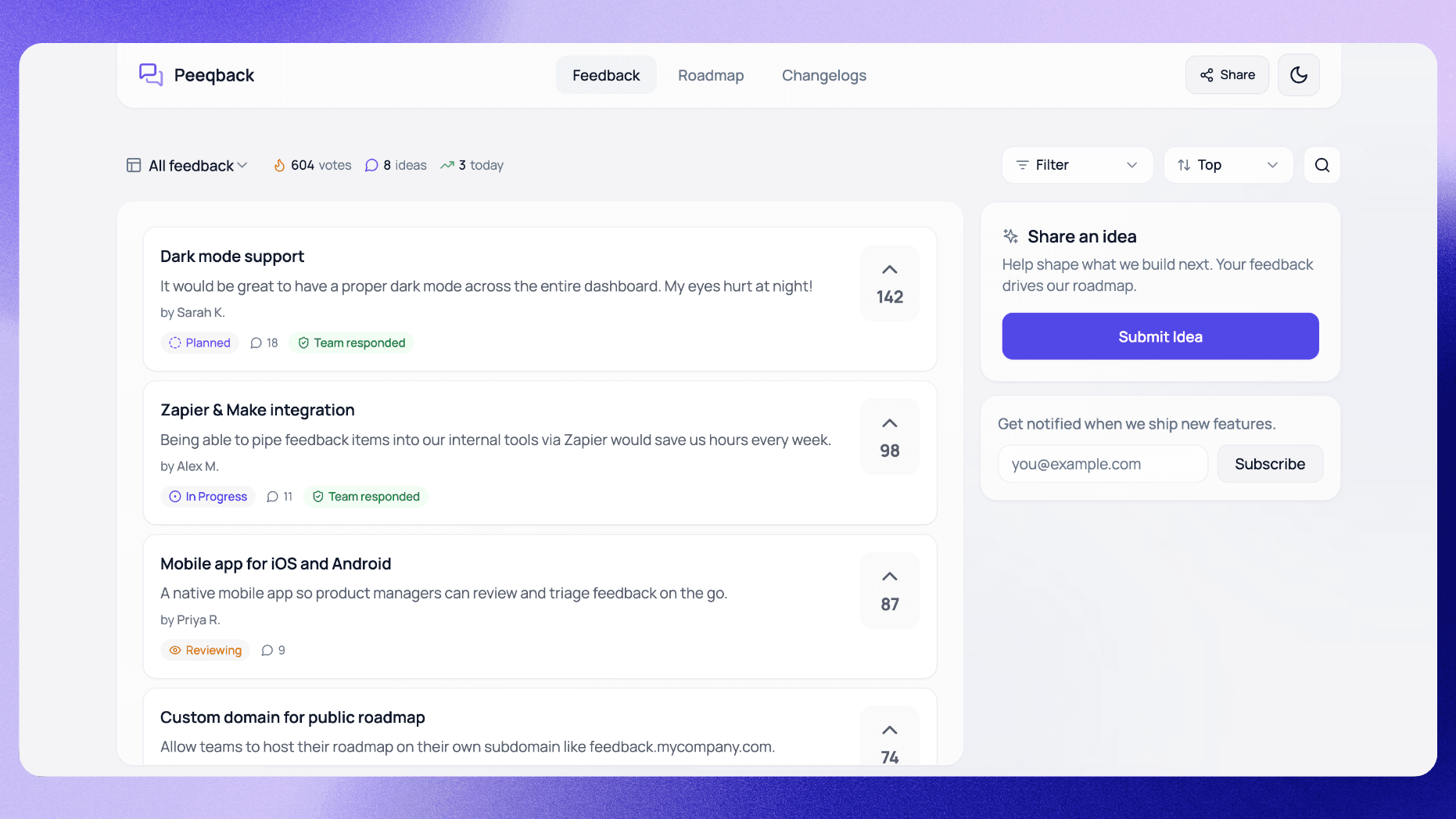
For a feature-by-feature deep dive, our Canny alternative comparison covers the full breakdown, pricing math included. If you want the same general shape as Canny without the tracked-user billing trap, Peeqback fits. If you want something more opinionated — Frill for design, Sleekplan for breadth — start there instead.
When Should Indie Hackers Just Use a Google Form?
Before your first 10 paying customers, skip the feedback tool entirely. A Google Form, a shared Notion page, or a pinned Twitter DM thread handles everything you need — and forces you onto 1-on-1 calls that matter infinitely more than any dashboard view.
Here's what the transition to a real tool tends to look like: somewhere around 20 to 50 paying users, the form responses stop scaling. You can't remember what people have asked, duplicates pile up, and nobody can see what was already requested. That's the signal — not revenue, not user count, but the moment your tracking breaks.
CB Insights found that 42% of failed startups cited "no market need" as the root cause of failure (CB Insights, 2024). The antidote isn't a nicer feedback board — it's 30-minute calls with people who've paid you money. A Google Form plus Calendly is the entire tech stack for most founders under $2K MRR.
When should you upgrade? Three signals:
- You're getting more than 10 feedback submissions per week
- Users are asking for features you've already built or already promised
- Weekly triage is taking more than 30 minutes
Hit any two? Pick a tool from the list above. Hit none? Keep using Google Forms and talk to your users directly. Your tools should scale with your problem — not ahead of it.
How Do These Alternatives Compare at a Glance?
Here's the comparison table I wish someone had shown me two years ago. All prices are monthly USD, lowest paid tier. The "Free tier" column shows the practical limit — not the marketing copy.
| Tool | Free Tier | Lowest Paid | Self-Host | Best For |
|---|---|---|---|---|
| Fider | Free (self-host) | ~$14/mo managed | Yes | Technical founders |
| UserJot | 2 boards, subdomain | $29/mo flat | No | Flat-pricing loyalty |
| Featurebase | Boards + roadmap + help center | $29/seat/mo | No | Solo founders |
| Sleekplan | Feedback + changelog only | $13/mo (3 seats) | No | All-in-one seekers |
| Frill | 14-day trial only | $25/mo | No | Design-conscious teams |
| GitHub Discussions | Unlimited, free forever | $0 | GitHub-hosted | Dev-tool SaaS |
| Peeqback | None (7-day money-back) | $19/mo or $149 lifetime | No | Flat-rate indie SaaS |
Which one should you actually pick? For most solo founders, the shortlist narrows fast: GitHub Discussions if devs are your audience, Featurebase free if you want generous limits on a single free tool, Peeqback if you want a low-friction flat-rate paid plan with a 7-day money-back guarantee, Sleekplan Indie if you want the widest feature set at the lowest price. The specialized picks — Fider for technical control, UserJot for flat-rate loyalty, Frill for design polish — solve specific problems once you've outgrown the free tiers.
Where Should You Start?
If you're reading this, you're probably either outgrowing Google Forms or about to waste money on Canny Pro. Neither is fatal. Pick one of the free tiers above — Featurebase or Sleekplan — and run it for a month before paying anything. Or test Peeqback's flat-rate plan for a week using the 7-day money-back guarantee.
Here's the order I'd actually recommend:
- Under $2K MRR with fewer than 10 users? Use Google Forms + Calendly. Talk to users directly.
- Developer-focused product? Start with GitHub Discussions. It costs nothing and your users are already there.
- Non-technical audience, ready to upgrade? Try Featurebase free, or Peeqback's flat-rate plan with a 7-day money-back guarantee — both let you prove the feedback workflow before committing long-term.
- Technical founder who likes infra? Self-host Fider. A $5 droplet plus Docker, done.
The one thing you shouldn't do is default to Canny because it has name recognition. Pricing friction is the single biggest reason indie hackers abandon feedback tools — and Canny's tracked-user model is the worst fit for a bootstrapped business. Your tools should make growth easier, not penalize it.
Ready to try a flat-rate option? Get started with Peeqback — no tracked-user billing, predictable pricing at $19/mo (or $149 once for lifetime), a 7-day money-back guarantee, and a public roadmap and changelog included from day one.

Written by
Jay KhatriJay is the founder of Peeqback. He builds tools that help product teams collect feedback, prioritize features, and ship changelogs users actually read.